Stable and accurate clock signals are essential in applications such as 5G communications, GNSS positioning, industrial control, and precision instrumentation. When higher frequency stability is required than a standard crystal oscillator can provide, TCXOs (Temperature-Compensated Crystal Oscillators) and OCXOs (Oven-Controlled Crystal Oscillators) are two common options.
Although both are designed to reduce frequency variation caused by temperature changes, they use very different approaches.
A TCXO compensates for temperature-induced frequency drift electronically, offering a good balance of frequency stability, compact size, low power consumption, and fast startup. An OCXO maintains the crystal at a controlled temperature, enabling significantly higher frequency stability and typically better long-term performance.
Choosing between them, however, should not be based on ppm or ppb specifications alone. Phase noise, aging, power consumption, startup time, size, operating temperature, and cost can all affect the right choice for a particular system.
How Does a TCXO Work?A TCXO uses a temperature compensation system to minimize frequency changes over temperature.
An internal temperature sensor monitors temperature variations, while the compensation circuitry adjusts the oscillator to compensate for the crystal's frequency-temperature characteristics. This allows the output frequency to remain relatively stable as the ambient temperature changes.
Because the crystal itself does not need to be maintained at an elevated constant temperature, TCXOs can achieve relatively low power consumption and compact package sizes.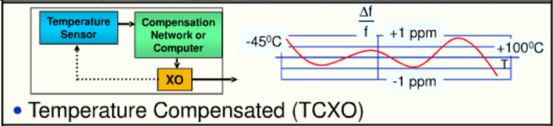
TCXOs generally offer:
These characteristics make TCXOs well suited for GNSS receivers, communication terminals, IoT devices, portable equipment, and industrial control systems.
An OCXO takes a different approach to temperature stability.
Instead of electronically compensating for changes in ambient temperature, an OCXO places the crystal and critical oscillator circuitry inside a temperature-controlled oven. A heater and temperature control circuit maintain the crystal at a stable operating temperature above the expected ambient temperature range.
By reducing the temperature variation experienced by the crystal, an OCXO can achieve much higher frequency stability than a typical TCXO.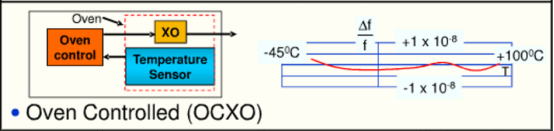
OCXOs generally provide:
These characteristics make OCXOs suitable for telecommunications infrastructure, precision instrumentation, satellite communication and navigation systems, reference clocks, and high-performance audio applications.
YXC offers TCXO solutions with frequency stability down to ±0.1 ppm and high-stability OCXO solutions for demanding timing applications. Actual specifications vary by product series, frequency, temperature range, and operating conditions. Refer to the corresponding datasheet for detailed specifications.
The main difference between a TCXO and an OCXO is not simply “accuracy.” Their different temperature-control methods affect power consumption, startup time, size, stability, and cost.
| Comparison | TCXO | OCXO |
|---|---|---|
| Temperature Control | Electronic temperature compensation | Temperature-controlled oven |
| Frequency Stability | Typically ppm to sub-ppm level | Typically ppb-level performance available |
| Power Consumption | Lower | Higher due to oven heating |
| Startup Time | Fast | Requires warm-up time |
| Size | Generally smaller | Generally larger |
| Cost | Generally lower | Generally higher |
| Long-Term Stability | Good | Typically better |
| Typical Applications | GNSS, IoT, communication terminals, industrial control | Telecom infrastructure, precision instrumentation, satellite systems, reference clocks |
The exact performance depends on the individual oscillator. A high-performance TCXO may outperform an entry-level OCXO in certain specifications, so the device datasheet should always be evaluated against the actual system requirements.
The best choice depends on the timing requirements and constraints of the system.
A TCXO is usually a better fit when the application requires good frequency stability but also places importance on size, power consumption, startup speed, and cost.
Typical examples include GNSS modules, portable devices, IoT terminals, communication equipment, and industrial embedded systems.
An OCXO is generally preferred when the application requires very high frequency stability, low frequency drift, strong holdover performance, or demanding phase-noise performance, and can accommodate higher power consumption, longer warm-up time, and a larger package.
Typical examples include telecom synchronization equipment, precision test and measurement instruments, satellite communication systems, and high-stability frequency references.
Frequency stability is important, but it is only one part of oscillator selection.
Depending on the application, engineers should also evaluate:
In other words, the oscillator with the smallest ppm or ppb number is not automatically the best oscillator for every application.
Does every 5G base station require an OCXO? Not necessarily.
Modern communication networks can use multiple synchronization technologies, including GNSS, Precision Time Protocol (PTP), and Synchronous Ethernet (SyncE). The oscillator requirements therefore depend on where the device is used within the synchronization architecture.
Small cells, communication terminals, and other cost- or power-sensitive equipment may use TCXOs when their stability and holdover requirements can be met.
OCXOs are more commonly considered in synchronization equipment, reference timing systems, and other infrastructure where higher stability and stronger holdover performance are required.
The oscillator should therefore be selected according to the system's synchronization architecture rather than simply according to whether the application is described as “5G.”
Yes. ±0.5 ppm is not a fixed performance limit for TCXOs.
Modern TCXOs are available with sub-ppm frequency stability, while high-performance designs can achieve even tighter specifications under defined operating conditions. YXC offers TCXO solutions with frequency stability down to ±0.1 ppm.
When comparing specifications, always check the corresponding temperature range, supply voltage, frequency, and other test conditions in the datasheet.
No. An OCXO can provide much higher frequency stability, but it also typically requires more power, more PCB space, longer warm-up time, and higher cost.
For many GNSS, IoT, portable, and industrial applications, a TCXO may provide sufficient timing performance with lower system overhead.
No. Frequency stability is only one of several important oscillator specifications.
Applications involving RF communication, high-speed data conversion, or precision measurement may also have strict requirements for phase noise, jitter, aging, and long-term stability.
The final oscillator selection should therefore be based on the complete timing requirements of the system.
TCXOs and OCXOs solve similar temperature-related frequency stability problems in different ways.
TCXO: better suited to applications that need a balance of stability, compact size, low power, fast startup, and cost.
OCXO: better suited to applications where very high frequency stability, long-term stability, and demanding phase-noise performance take priority over power, size, and warm-up time.
YXC provides TCXO and OCXO solutions for communications, industrial, GNSS, instrumentation, and other timing applications.
For product specifications, datasheets, or technical support, contact YXC with your frequency, frequency stability, operating temperature, supply voltage, output type, phase noise or jitter requirements, and application information.